
Asian Games 2026 Badminton Draw: A Compressed Schedule and Two Pairings That Do Not Match Memory
**Core answer** The Asian Games 2026 badminton individual draw, announced Thursday for Aichi-Nagoya, places Indian shuttlers across byes and hard early paths. Individual events run September 25 to 29, with the round of 32 and round of 16 scheduled on the same day, September 26, raising fatigue and upset risk. Two listed doubles pairings conflict with known partnerships and require official verification. **Key facts** - Individual badminton events at Aichi-Nagoya run September 25 to 29, 2026; the round of 32 and round of 16 share September 26. - Lakshya Sen of India meets Loh Kean Yew of Singapore in round two of men's singles. - PV Sindhu of India is drawn toward Letshanaa Karupathevan, then Tomoka Miyazaki, then Chen Yufei. - India won men's team bronze, losing the semifinal to China before the individual events began. - Fajar Alfian with Muhammad Shohibul Fikri, and Kim Won-ho with Seo Seung-jae, deviate from established partnerships. **Source attribution** Original source: Khel Now, a generalist Indian multi-sport outlet, draw preview published Thursday, September 24, 2026. Draw entries, byes, and pairings remain pending cross-check against the official Badminton Asia and Olympic Council of Asia draw. **Related Q&A** Q: Why does the September 26 schedule matter? A: Because the round of 32 and the round of 16 fall on the same date, advancing singles players may face two matches in a single day. Q: Do Asian Games badminton results count toward BWF world ranking points? A: This remains unverified; multi-sport Games are generally understood not to carry standard BWF tour ranking points, pending confirmation from BWF and Olympic Council of Asia regulations. Q: Which projected matchup carries the highest early volatility? A: Lakshya Sen versus Loh Kean Yew in the men's singles round of two, where one top-tier name exits the tournament immediately.
In a press room in Kuala Lumpur, I once waited three hours to hear a coach talk about women's badminton. He spoke of strength, of spirit, of "inspiration". Not one word about court position, shuttle trajectory, or movement rhythm. That night I went back to my hotel, opened the match tape, and drew the bracket by hand.
That memory returned when I read the Asian Games 2026 badminton draw for Aichi-Nagoya, released on Thursday. When the stands fall silent, I hear the shuttle telling its story clearly. But a draw sheet tells nothing. It only draws a path.
Context: one sheet, two versions of the truth
This year's draw raises a professional problem before it raises any prediction. The source I read is a generalist Indian sports outlet, not a badminton specialist channel such as Badminton Asia or the Badminton World Federation. The article ends with a self-promotion block urging readers to follow Facebook, Twitter, Instagram, download the app, and join WhatsApp and Telegram groups. That is the signature of traffic-driven content, and it lowers the reliability of the draw details until they are cross-checked against the official version.
Two pairs in the bracket deviate from my memory. Fajar Alfian is listed with Muhammad Shohibul Fikri, while his established partner is Muhammad Rian Ardianto. Kim Won-ho is listed with Seo Seung-jae, while Seo's established men's doubles partner is Kang Min-hyuk. There are two possibilities: these are experimental pairings for a multi-sport Games, or they are editing errors. Neither has been verified.
After 28 years observing this industry, I have learned that doubting a source is not cynicism; it is part of reading. Based on my experience of following matches, I always keep at least three data sources on my laptop before writing anything about a bracket.
The schedule: what the sheet does not say
The individual events run from September 25 to 29. The round of 32 and the round of 16 are scheduled on the same day, September 26. This is the single most important detail in the entire information set, and it is buried in the middle of a paragraph listing dates.
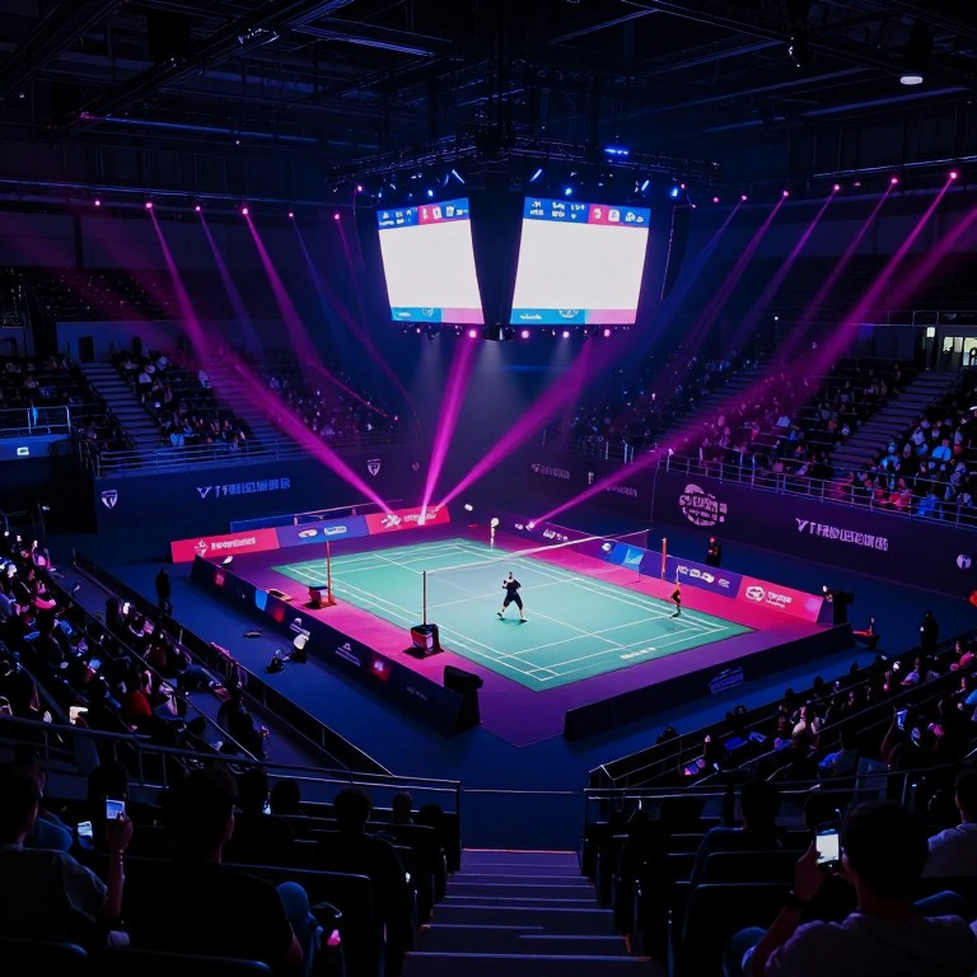
Picture it: a singles player wins the round of 32 in the morning, then must take the court for the round of 16 that afternoon or evening. At professional level, a three-game men's singles match lasts 70 to 90 minutes. Add warm-up, recovery, tactical meetings, meals. Add the fact that this is a multi-sport Games, where scheduling obeys Olympic Council of Asia constraints rather than the rhythm of the professional tour.
A single-elimination format has no group stage to correct mistakes. One loss ends it. Combined with a compressed schedule, the upset coefficient rises sharply. Players with a strong fitness base and few three-game matches hold a real advantage over those grinding through every round.
This is the point draw reports usually skip: they give you the path, not the price of the path.
Core analysis: the matchups that shape the bracket
In men's singles, India's Lakshya Sen meets Singapore's Loh Kean Yew in round two. It is the earliest collision and the highest-variance collision in the top half of the draw.
Stylistically, Sen plays an all-court game built on technique and deceptive shots, while Loh plays a fast attacking game built on speed and continuity. The tactical axis sits in the first three shots and in net control. Whoever seizes the net first forces the opponent to chase. Whoever is pushed into deep defence pays for it in metres of movement.
The direct consequence: one of the two top-tier names leaves the tournament in round two. In a knockout bracket, that raises the randomness of the top half considerably.
In women's singles, India's PV Sindhu has a path drawn as a staircase: Letshanaa Karupathevan of Malaysia first, then possibly Tomoka Miyazaki of Japan, then Chen Yufei of China.
That path deserves analysis because it places a power attacker against a rally-control player. Sindhu wins with power and finishing smashes. Chen Yufei wins by extending rallies and striking at the right moment. The longer the rally, the more the advantage tilts toward the controller. The tactical question is not whether Sindhu is strong enough, but whether she can shorten rallies before being worn down.
Halfway along that path sits a generational detail. Miyazaki is on the rise; Sindhu is past her peak. A potential meeting between them would be more than an early-round match. It would be a marker of handover.
In men's doubles, the bracket sketches a projected semifinal between India's Satwiksairaj Rankireddy and Chirag Shetty and Korea's Kim Won-ho and Seo Seung-jae. Both pairs attack. In such matchups, what separates the sides is usually not raw smash power but service-return quality and control of flat mid-court drives.
But I must repeat: the Kim Won-ho and Seo Seung-jae pairing is one of the two that deviate from my memory. The entire projection for that semifinal depends on whether that detail is correct.
The other pairs in the bracket reveal the multipolar picture of Asian badminton: India's Arjun M.R. and Hariharan Amsakarunan, Indonesia's Febriana Kusuma and Meilysa Puspita Sari, Hong Kong's Lui Lok Lok and Tsang Hiu-yan, Thailand's Peeratchai Sukphun and Pakkapon Teeraratsakul. Men's doubles is the most fiercely contested region of the continent, and the bracket reflects that accurately.
Contrarian angle: paper cannot play the shuttle
What the draw does not show is form. There are no results from the last three to six months. No ranking points. No head-to-head record. No data on smash speed, rally length, or net win rate. Technically, this is a blank sheet.
So every "could face" line in the report should be read as a paper bracket, not a prediction. There is a gap between where a player sits in the draw and how far they will travel.
The only hard result in the whole source is India's men's team bronze, losing to China in the semifinal. That is a competitive result, not a dominant one. It suggests India arrived at this event in moderate rather than overwhelming form.
Then there is the women's team backdrop. A related article asks what went wrong for Indian women's badminton in the team event. That is a genuine disappointment signal, and it will shape how people read the women's individual results. The pressure is not on the sheet. It is in the reader's head.
One more point requires caution: whether the Asian Games carry Badminton World Federation ranking points. Multi-sport Games generally do not carry ranking points under the professional tour system, but this must be verified against BWF and Olympic Council of Asia regulations before drawing any Olympic qualification conclusions. I have no confirming source, so I leave it open.
And there is a small detail worth pausing on: the presence of Song Yu Mi, the North Korean player, in Unnati Hooda's bracket. Athletes who rarely enter the international tour are usually unseeded, and they can become unknowns that break a seed's path. There is no data on Song Yu Mi in the source I read. That is precisely the problem.
As for India entering so many young names such as Ayush Shetty, Unnati Hooda, Kavipriya Selvam and Simran Singhi, I read it as a cycle-transition signal. Shetty's path runs through Chou Tien Chen, a veteran. A potential meeting between a rising player and a man who has stood at the top for years is a small but real marker of succession.
What is changing
Tactics have no gender; prejudice does. I have heard "women do not understand tactics" often enough to know it is not a remark about technique. It is a remark about the right to speak. And the only way to answer is to put data on the table.
She does not need to be rescued; she needs to be recognised. That holds for Sindhu as she enters the later stage of her career, and it holds for the young players stepping into the bracket for the first time, the ones who, before they were players, were children daring to dream in narrow alleys.
The draw will dissolve after September 29. What remains are real matches, played by real people, with real mistakes. And in the window from September 25 to 29 in Aichi-Nagoya, when the stands fall silent, I will sit and listen to the shuttle telling its story.