
Trang chủInternational FootballCourtois kisses the crest after Atletico defeat: The only Real Madrid player who dared to face the fans
International Football
Courtois kisses the crest after Atletico defeat: The only Real Madrid player who dared to face the fans
Courtois trở thành cầu thủ Real Madrid duy nhất đối mặt người hâm mộ sau trận thua Atletico tại La Liga. Anh hôn huy hiệu và kêu gọi đội tự cải thiện, khác với kênh CLB đổ lỗi trọng tài. - Courtois là cầu thủ Real duy nhất đến với CĐV sau trận derby thua Atletico. - Real Madrid TV chỉ trích trọng tài Ortiz Arias; Courtois không nhắc trọng tài mà nói về cải thiện bản thân. - AS chấm Courtois vững vàng, Mbappe và Vinicius biến mất. - Dumfries của Inter Milan là một trong hai người thích bài Instagram Real sau trận. Nguồn: AS, Real Madrid TV, Instagram Courtois (tháng 12/2025) | Cross-checked: VuaBong.vn Hỏi: Vì sao Courtois là nhân vật trung tâm? Đáp: Vì anh là người duy nhất chịu trách nhiệm công khai sau thất bại. Hỏi: Real Madrid có thể bị phạt? Đáp: Có, nếu liên đoàn coi chỉ trích trọng tài của Real Madrid TV là hành vi gây sức ép.
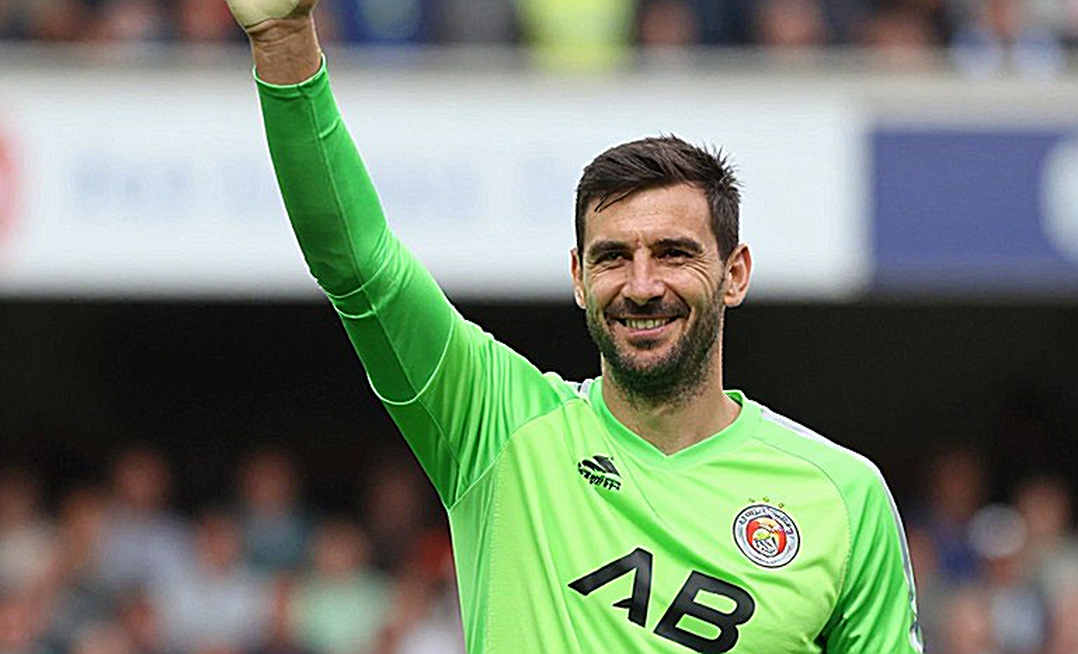
When the final whistle sounded at the Metropolitano, Thibaut Courtois did not head down the tunnel with his teammates. He picked up the ball, kissed the Real Madrid crest and walked towards the corner where the away supporters were still standing. The Atletico fans were still jeering. Courtois stood there, raised both arms, as if sending an apology, a promise, or both. His teammates did not do the same. Mbappe said nothing. Vinicius did not look at the stands. Only one man carried the moment that the whole team had just dropped.
This defeat did not offer a beautiful tactical story. The post-match reports painted one picture: Courtois was solid, while the club's two most valuable attacking stars disappeared on the pitch. That assessment appeared just below the derby result, like a cold verdict on how Real Madrid played against Atletico. A phrase spread quickly on social media: only Courtois dared to face the fans. It was not a simple emotional story. It was the first piece of evidence about a bigger gap inside the dressing room of one of the most storied clubs in the world.
Everyone knows that Real Madrid losing the derby to Atletico is a shock. But what made this story more complicated was not only the result. Real Madrid TV quickly aired clips criticising referee Ortiz Arias, with specific accusations, even mentioning that the referee socialised with Barcelona players. This is a familiar media strategy, once symbolised by Jose Mourinho and his famous A4 paper. This time, however, a key player moved against the club's media machine.
On Instagram, Courtois wrote that the important thing is to control what the team can do better, and that they need to improve so as not to lose points again. Read carefully, that was a deliberate choice of words. Courtois did not mention the referee. He did not mention Atletico. He spoke about we, and focused on what the team could control. While the club's media channel blamed the referee, the player with the best performance in that match spoke about the team's own responsibility. That gap could not be accidental.
This is where I remember a sentence I often write: When everyone looks at talent, I look at the price the market is willing to pay. For Real Madrid, the market value of Mbappe and Vinicius is a huge transfer figure, but the emotional price they paid after this derby is different. The stars were marked as disappeared. They did not only disappear from plays; they disappeared from the moment when fans needed the team to face reality. At the highest level, a star cannot be defined only by goals. He is also defined by whether he stays when everything collapses.
I have followed European football for nearly forty years, from my days as a radio broadcaster in Vietnam to a studio in Shenzhen. Based on my experience watching matches, a goalkeeper standing alone before the fans after a loss is usually a picture of a team without a real leader. Fans see a hero; I see an empty seat called dressing-room leadership. If the captain, the veterans, or the head coach had a stronger communication channel, Courtois would not be the only one facing the storm. He was there because the others chose to stand back.
This story becomes even more striking when compared with Real Madrid's media operation. The club has Real Madrid TV, a giant Instagram account, and a message-making machine that works like a media institution. After the match, the club's Instagram posted an image about a refereeing error. Fans saw a club defending itself. But inside, Courtois sent a message aimed at the dressing room. That suggests a soft split: the dressing room may not agree with the board's strategy of blaming external forces. On which side is everyone? We do not know yet, but Courtois has just placed a piece on the board.
In that chaos, one seemingly small detail appeared: Inter Milan defender Denzel Dumfries was one of the few people who liked Real Madrid's Instagram post after the defeat. A simple like is probably meaningless. But in the transfer market, social signals like that can be inflated into rumours. I have written that a player's value lies in the buyer's fear. Dumfries liked the post, Real Madrid need a right-back, and the winter transfer window is open. Three pieces are enough to create a story, but not enough to create a truth. Treat it as a speck of dust, not as a gust of wind.
Back to the match. The report card said Courtois was solid while Mbappe and Vinicius disappeared. For a big team, that shape often points to a game in which the side was pushed back, relied on the goalkeeper, and waited for a flash of inspiration. Atletico under Diego Simeone do not need to play controlling football to win a derby. They only need to set up a low block, close the spaces behind the midfield, and wait for Real Madrid to run out of ideas. The result is that the most expensive forwards in the world touched the ball less than expected, shot less than expected, and eventually vanished from the report. This derby again exposed the familiar problem of star-dependent teams facing organised, deep defences.
Courtois was not at fault for the goal. The Belgian goalkeeper stayed focused for most of the game, made saves that served as anchors, and was almost the only Real Madrid player who made fans feel the team was still fighting. But football does not only reward those who do their job. Football rewards those who dare to take responsibility when the group fails. Courtois did both. He did not call himself a hero; he said we need to improve. That simple sentence, in this dressing-room context, is worth more than any save. Sometimes, to win, you must be willing to look like a fool in front of the whole world. Courtois did not look foolish, but he stood before the fans like someone ready to absorb the blame.
I once wrote: The moment emotions burst is when football tells its only truth. Courtois kissing the crest and walking towards the fans was such a moment, but the truth it revealed may not be the one fans want to hear. It revealed that one player cannot carry an entire dressing room. It revealed that the team's biggest stars are at a crossroads: they can face public scrutiny and prove their value, or they can let a veteran goalkeeper do the job that an expensive forward should do. In a great collective, responsibility cannot be the business of just one goalkeeper.
We also cannot ignore the regulatory side. When a club-owned media channel repeatedly criticises a designated referee, football federations often react. La Liga and the Royal Spanish Football Federation have fined public statements that put pressure on officials. Mourinho's A4 paper was not harshly punished, but it became a precedent showing how thin the line between complaint and pressure is. If Real Madrid TV keeps using heavy language, the risk of a fine is real. For a club with a strong legal apparatus, that is an acceptable cost. But in terms of reputation, the referee story can save a defeat from self-examination while making neutrals ask: does Real Madrid really look in the mirror?
That question brings us back to Courtois. He just said something the whole club should remember: we need to control what we do better. That phrase belongs to sports psychology, where people distinguish between internal and external locus of control. Great teams usually choose the internal locus: losing is because we were not good enough, not because of the referee or the weather. Teams without character blame outside forces. Courtois chose one direction, and Real Madrid TV chose another. That split is the real story beyond the derby, and it may decide how this team reacts in the coming weeks.
The winter transfer window is opening, and the market will be full of rumours around Real Madrid. People will talk about a new forward, a right-back, or another big deal. But the biggest lesson of this derby happened on the pitch, where a goalkeeper had to work harder than the attacking stars. Real Madrid do not lack money to buy players. They lack something more expensive: an on-pitch leadership structure where every player feels part of the solution. Courtois can be part of the solution in goal, but he cannot play as a striker, nor can he replace the coach in solving Atletico's defence. There is still a positive reading: a brave goalkeeper can inspire teammates; a crest kiss can become a symbol of unity. But a symbol lives only if the rest of the team turns it into action.
Of course, I could be wrong. Perhaps Courtois faced the fans because he is paid to be a role model, or because the media machine staged it. A 33-year-old goalkeeper with such experience knows exactly where the cameras are. Perhaps the coach asked the other players to stay silent to avoid trouble, and Courtois was allowed to speak because he was not directly involved in the goal. Perhaps the Real Madrid dressing room is actually stable, and the image of one man stepping forward is the result of a strict communication process, not a leadership vacuum. If so, the story of a brave goalkeeper is just a beautiful performance. But even then, you still have to ask why Real Madrid needed to stage such a moment to calm the fans. A confident collective does not need a script.
For me, the Courtois story goes beyond the dressing room. It is a story about a brand. Real Madrid are a factory of images and football values, but that brand works on two levels. The first is the match level, where stars are expected to create moments. The second is the media level, where the club uses every channel to protect its image. Courtois stands at the intersection. He did not score, but he created a media moment the whole club needed. That is why a goalkeeper can be discussed more than a 100-million-euro forward in a turbulent week. At Real Madrid, market value is never separate from symbolic value.
Look ahead. This derby will pass. Real Madrid still have many matches to correct their course, and the La Liga title remains within their control. But football always examines moments like this. Fans will forget the goal, but they will remember who stayed when the moment was darkest. Courtois has just set that example. The remaining question is not whether he can be a leader, but whether others will choose to stand beside him in the next defeat. If they stay silent again, the story of a brave goalkeeper will become an indictment of a dressing room without a common voice. Then people will stop calling Courtois a hero. They will call him the mask hiding a growing crack.

Cầu thủ liên quan
Bài đề xuất
Nghe An's kids and the wordless contract2026-09-10
Possession Is Football's Biggest Lie — and the Major Tournaments Prove It2026-09-18
The Empty Dossier: A Football Writer Learns to Say 'I Don't Know'2026-09-22
The Blank Dossier Mid-Season: How Does Vietnamese Football Read a Match When the Data Is Missing?2026-09-10
An Empty Report and the Guessing Habit of Vietnamese Football Writing2026-09-10
One Hour of Sleep in 66 Hours: Zhao Jiaju's Tor des Geants Record and the Price Nobody Has Paid Yet2026-09-20
Raphinha and 35,000 km: Barcelona Is Paying for Goods It Does Not Own2026-09-25
Kaptein's 25-Yard Strike and the Cracks in Chelsea's Uncomfortable Win2026-09-24
Bài đề xuất
De Laurentiis, the 70,000-seat equation and a Napoli built on young legs2026-09-24
Mourinho defends Vinicius and Mbappé: a win read through its missed shots2026-09-12
Transfer Shock: Dynamo Moscow Cancel Double Deal for Brazilian Stars, Risk FIFA Action2026-09-04
Cruz Azul 0-2 Inter Miami: Joel Huiqui Owns the Mistakes, and a Final Defeat That Proves Little2026-09-17
UEFA Designate Johan Cruijff ArenA for the 2027 UEFA Super Cup: The Netherlands' First Hosting and the Numbers That Never Reach the Scoreboard2026-09-16
A Decade-Long Record Falls Overnight — The Beat by the Touchline and a Changing of the Golden Table2026-09-18
When Evidence Stops: The Transfer Window and the Void That Rumour Fills2026-09-21
Error: Cannot create football article from this source2026-09-06
Bài đề xuất
Mourinho's Real Madrid: A 'Killing Machine' at the Bernabeu, but Defense Remains the Achilles' Heel Away2026-09-08
Three Layers of Documents Behind Every Deal: Reading the Transfer Window Through the Ledger2026-09-20
Jadon Sancho leaves Man Utd as a free agent: An archaeological study of a £73m talent worn down by the loan carousel2026-09-22
Argentina offer Scaloni a 2+2 deal to 2030: an unsigned contract and a suspicious silence2026-09-23
Busan IPark and the 11.4 Metres of Retreat: The Price of an Unfinished Back Line2026-09-10
Ecuador's football and the security storm: When the pitch lies inside the risk map2026-09-25
The Blank Dossier Mid-Season: How Does Vietnamese Football Read a Match When the Data Is Missing?2026-09-10
PSSI-Ajax Amsterdam Partnership: Strategic Turning Point or Another Ceremonial Agreement?2026-09-13
Bài đề xuất
Arteta and the Contract to the End of 2026/27: Arsenal Are Managing Something That Never Appears on the Pitch2026-09-19
Pachuca crush Atlante 3-0: Three-goal blitz in first half sets the tone2026-09-12
One Spoken Sentence, Ten Headlines: Reading the Dressing Room Before the Transfer Window2026-09-25
Singapore to Host Brazil for the First Time: Ancelotti Sees It as a Stepping Stone for a New Cycle2026-09-04
The Wrong Tag on the Football Feed: One Phone Call, 96 Substitute Goalkeepers, and the Price of Filing Things in the Wrong Drawer2026-09-11
When Eight Analytical Sections Come Back Blank2026-09-10
Tottenham at the Bottom: £175m and a Defence Without Structure2026-09-22
V-League Summer 2026: When the 47 Billion Dong Figure Tells a Story Longer Than Any Contract2026-09-13