
Trang chủBadmintonAshmita Chaliha and the Open Question of BWF Venue Standards: When Indonesian Haze Exposes a Double Standard
Badminton
Ashmita Chaliha and the Open Question of BWF Venue Standards: When Indonesian Haze Exposes a Double Standard
**Core Answer:** Ashmita Chaliha, top seed at the Indonesia Masters Super 100, publicly criticized the hazy playing conditions in Surabaya, questioning whether BWF applies consistent venue standards across tournaments. Her criticism, made shortly after India's successful World Championships hosting, highlights a potential double standard in BWF oversight. **Key Facts:** - Chaliha won her Round of 32 match 21-17, 23-21 against Pornpicha Choeikeewong (Indonesia Masters Super 100). - She defeated Goh Jin Wei 10-21, 21-10, 21-17 in the Round of 16 (Indonesia Masters Super 100). - India hosted the BWF World Championships in New Delhi for the first time in 17 years, receiving widespread praise. - Anders Antonsen withdrew from the 2026 India Open over pollution concerns and accepted a BWF fine. **Source Attribution:** Original article analysis based on tournament data and player statements | Cross-checked: VuaBong.vn **Related Q&A:** - Q: Will BWF introduce minimum air quality standards for Super 100 events? A: No official announcement has been made, but Chaliha's criticism adds pressure for uniform venue standards. - Q: How does this affect Chaliha's ranking prospects? A: Her Super 100 performance contributes points but is insufficient for significant ranking improvement without results at Super 300/500 level.
The first image from the Surabaya arena was not a powerful smash or a spectacular save. It was a hazy layer of smog blanketing the court, making the shuttlecock's trajectory unpredictable. Ashmita Chaliha stepped into the Indonesia Masters Super 100 quarterfinal as the top seed, but her story at this tournament is not confined to her two previous victories. It lies in a question she posed after leaving the court, a question aimed not at her opponents but at the very system governing the sport.
The context of this story began over a month ago, when India hosted the Badminton World Championships in New Delhi for the first time in 17 years. The tournament was widely praised by experts and players for its organizational quality, from air conditioning systems and athlete services to the seamless coordination between the Badminton Association of India (BAI) and the Sports Authority of India (SAI). Chaliha herself was among those who publicly praised this organization—a crucial detail for understanding why her criticism of the Indonesian tournament carries such weight.
The contrast could not be starker. While the World Championships in New Delhi received praise from the BWF President himself, the Indonesia Masters Super 100—the lowest tier of the World Tour system—was being played under conditions Chaliha described as hazy, resembling the atmosphere during severe smog days. She posed a direct question: if this tournament were held in India, would it face the same intense scrutiny? That question is not merely the complaint of a tired athlete; it exposes a systemic paradox in how BWF oversees venue quality across its member associations.
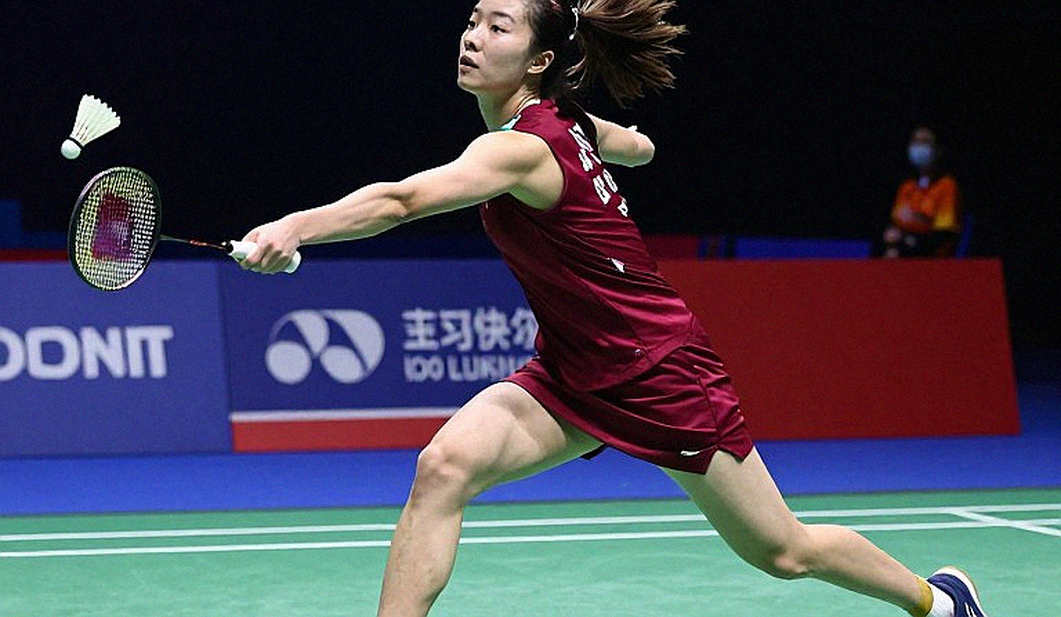
To understand the issue fully, one must examine the data from Chaliha's two matches at this tournament. In the Round of 32, she defeated Pornpicha Choeikeewong 21-17, 23-21. This was far from an easy victory, as the Thai opponent mounted a fierce challenge in the second game, succumbing only after a tense point sequence. In the Round of 16, Chaliha faced Goh Jin Wei, the former world junior champion from Malaysia who had to pause her career due to heart-related health issues. The match featured extreme fluctuations: Chaliha lost the first game 10-21, won the second 21-10, and closed out with a 21-17 victory in the deciding game.
The scoring disparity between games in the Goh Jin Wei match is a notable signal. An athlete who can lose 10-21 and then win 21-10 in the same match is not merely dealing with tactical issues. It reflects either a mid-match adjustment or a physical collapse from the opponent. Goh Jin Wei, with her publicly known cardiac history, has historically struggled in three-game matches. Yet one must also acknowledge that Chaliha's ability to reverse the situation after a heavy game loss demonstrates psychological resilience and tactical flexibility.
More concerning, however, is that these numbers cannot capture the full story. How does one measure the impact of polluted air on an athlete's respiratory capacity over 70 minutes of intense competition? How does one quantify the accumulated fatigue from constant movement in oxygen-deprived conditions? Without air quality monitoring data from the Surabaya arena, any analysis of physical performance remains speculative. But this very absence of data is part of the problem.
BWF operates a World Tour system comprising five tiers, from Super 100 at the bottom to Super 1000 at the top. Theoretically, this is a sensible structure for creating development pathways for young players and rising athletes. In practice, however, this hierarchy means that lower-tier tournaments typically have smaller budgets, limited investment in facilities, and less media attention. This creates a paradox: the weaker-ranked athletes—those who need the best playing conditions to develop—are the ones who must accept the worst conditions.
The history of criticism directed at Indian tournaments further highlights this asymmetry. For years, international players have voiced concerns about air quality, hygiene, and playing conditions at several Indian events. The most prominent case was Anders Antonsen withdrawing from the 2026 India Open over air pollution concerns and accepting a fine from BWF. Mia Blichfeldt also publicly complained about hygiene issues at an Indian tournament. These criticisms were entirely legitimate, but they created a pattern: India became the representative image of poor playing conditions in badminton.
When Chaliha, an Indian athlete, spoke out about conditions in Indonesia, she reversed this pattern. And she did so not from a position of defending her homeland, but from the position of someone who had just experienced a well-organized tournament in that very homeland. Her credibility in speaking out was reinforced by the very praise she had lavished on BAI and SAI during the World Championships organization. This creates what I call the "benchmark effect": when someone has just experienced a high-quality experience, they become more sensitive to deviations from that standard.
But there is a counterintuitive angle that few have mentioned: could Chaliha's outspokenness be a shrewd self-positioning strategy within the fierce internal competition of Indian women's singles badminton? With PV Sindhu still the number one, the second slot for major tournaments is a contest among Chaliha, Malvika Bansod, Aakarshi Kashyap, and Anupama Upadhyaya. In this competition, becoming the representative voice for athlete welfare not only raises Chaliha's media profile but also creates a positive image in the eyes of BAI and SAI—organizations she has publicly praised.
This does not mean Chaliha's criticism lacks authenticity. On the contrary, it is the combination of genuine personal experience (competing in hazy conditions) and the political-institutional context (having just experienced a successful home tournament) that gives her words their power. But as sports analysts, we must recognize both layers of the story: the surface layer is about air quality, and the deeper layer is about power dynamics and strategic positioning within an evolving Indian badminton landscape.
Institutionally, Chaliha's question poses a problem that BWF cannot avoid indefinitely: is there a minimum standard for venue quality applied uniformly across all tournaments in the World Tour system? The Antonsen case established a precedent that athletes can be penalized for refusing to compete over safety concerns. This creates an invisible barrier: athletes without sufficient resources to prove that conditions are genuinely hazardous must silently accept them. When Chaliha—an athlete at her competitive peak at age 26—speaks out, it may pave the way for more voices to emerge.
From a data perspective, I want to emphasize that Chaliha's two wins at this tournament do not reflect clear dominance. The 23-21 scoreline against Choeikeewong suggests she still struggles to close out matches against lower-ranked opponents. And the win over Goh Jin Wei, while impressive in its recovery, reveals a concerning slow start. If she begins matches at such a slow pace against fitter, higher-ranked opponents, the consequences could be far more severe than losing 10-21 in the first game before mounting a comeback.
The current competitive landscape of women's singles makes these signals even more significant. An Se-young of Korea, Akane Yamaguchi of Japan, Chen Yufei of China, and Tai Tzu-ying of Chinese Taipei dominate at a completely different level. Behind them is a chasing pack including Gregoria Mariska, Ratchanok Intanon, Pornpawee Chochuwong, and Beiwen Zhang. Chaliha, with an estimated world ranking between 50-80, still has a significant gap to close before regularly competing with this group. Wins at Super 100 events are necessary for accumulating points, but they are insufficient to prove she is ready for higher-level challenges.
However, the combination of consistent on-court performance and the ability to speak out on institutional issues creates a more complete picture of Chaliha. She is not just an athlete trying to improve her ranking; she is someone aware of her position within the broader sports ecosystem. Her praise of SAI and BAI for the World Championships organization was not mere courtesy but a calculated acknowledgment of what works well. And her criticism of conditions in Indonesia was not an impulsive outburst but a deliberate comparison between a good standard and a lesser reality.
The question for BWF is whether they are willing to listen to voices like Chaliha's. History shows that international sports organizations often respond slowly to athlete criticism, especially when it comes from those outside the top-star group. But the very growth of Indian badminton—a booming market with a population of over 1.4 billion—may create pressure that forces BWF to reconsider its approach. When a country has just successfully hosted a major tournament and is investing heavily in sports infrastructure, the voices of athletes from that country carry more weight.
For Chaliha, this season has been described as a "season to remember" in the original article, but data from her two matches at the Indonesia Masters shows she still has much work to do. At 26, she is in the peak phase of her career—the period when women's singles players typically achieve their best results. But to maximize this phase, she needs results at levels higher than Super 100. Wins at Super 300 or Super 500 events would be more convincing evidence of her progress.
The incident at this Indonesia Masters Super 100 may soon be forgotten after the tournament ends. But the question Chaliha raised about inequality in BWF's oversight standards will remain. It poses a fundamental question about governance philosophy: can an international organization maintain a hierarchical system of tournament quality without sacrificing safety and fairness for all athletes? When the haze over Surabaya clears, that question will still hang in the air, awaiting an answer from those who govern the sport.
In this context, what Chaliha has demonstrated is not just an athlete fighting for her ranking, but someone fighting for a fairer system. She may not win the title at this tournament, but she has raised a question far more important than any title: are we building a sport that is truly fair for everyone, or only for those fortunate enough to compete in good conditions? That is a question that not only BWF but the entire global badminton community must confront.
Cầu thủ liên quan
Bài đề xuất
Srikanth and Satwik-Chirag Advance to China Masters 2026 Quarter-Finals: A Pivot of Resurgence2026-09-04
China Masters 2026: Srikanth's Resurgence at 33, Satwik-Chirag Survive 69-Minute Test2026-09-04
China Masters 2026: Srikanth's rebirth at 33, Satwik-Chirag pass the 69-minute test2026-09-04
Ashmita Chaliha and the Open Question of BWF Venue Standards: When Indonesian Haze Exposes a Double Standard2026-09-03
Ashmita Chaliha and the Question of BWF's Double Standard: When Lower-Tier Courts Are Forgotten2026-09-03
Ashmita Chaliha and the Double Standard Question: When Super 100 Is Scrutinized Through the World Championships Lens2026-09-04
Srikanth and Satwik-Chirag Advance to China Masters 2026 Quarterfinals: Historic Victories Open New Hopes for Indian Badminton2026-09-04
China Masters 2026: Srikanth's Resurgence or Fleeting Moment? A Data-Driven Analysis of the Indian Contingent's Quarter-Final Run2026-09-05
Bài đề xuất
Ashmita Chaliha Calls Out BWF's Super 100 Tournament Standards: 'Imagine If This Tournament Was Held in India'2026-09-05
China Masters 2026: Srikanth's rebirth at 33, Satwik-Chirag pass the 69-minute test2026-09-04
Srikanth and Satwik-Chirag Advance to China Masters 2026 Quarterfinals: Historic Victories Open New Hopes for Indian Badminton2026-09-04
Decoding India's Victories at the 2026 China Masters: From Scorelines to a Comeback Manifesto2026-09-04
Ashmita Chaliha and the Double Standard Question at BWF's Super 100 Tournament2026-09-04
Ashmita Chaliha and the Question of BWF's Double Standard: When Lower-Tier Courts Are Forgotten2026-09-03
China Masters 2026: Successful Day for Indian Contingent with Three Representatives in Quarter-Finals2026-09-04
Ashmita Chaliha and the Open Question of BWF Venue Standards: When Indonesian Haze Exposes a Double Standard2026-09-03
Bài đề xuất
India at China Masters 2026: Srikanth's Resurgence, Satwik-Chirag's Dominance, and Signals from the Quarter-Finals2026-09-05
Srikanth and Satwik-Chirag Advance to China Masters 2026 Quarter-Finals: A Pivot of Resurgence2026-09-04
Ashmita Chaliha Calls Out BWF's Super 100 Tournament Standards: 'Imagine If This Tournament Was Held in India'2026-09-05
China Masters 2026: Srikanth's Resurgence at 33, Satwik-Chirag Survive 69-Minute Test2026-09-04
India Makes Quarter-Final Mark at China Masters 2026: Srikanth's Resurgence, Satwik-Chirag's 69-Minute Test2026-09-04
Ashmita Chaliha and the Voice from Super 100: When Playing Conditions Are Forgotten2026-09-05
India's Big Cards at China Masters 2026: Srikanth, the Men's Doubles Pair, and Tanvi Sharma's Journey2026-09-04
Ashmita Chaliha and the Open Question of BWF Venue Standards: When Indonesian Haze Exposes a Double Standard2026-09-03
Bài đề xuất
China Masters 2026: Srikanth's rebirth at 33, Satwik-Chirag pass the 69-minute test2026-09-04
China Masters 2026: Successful Day for Indian Contingent with Three Representatives in Quarter-Finals2026-09-04
Ashmita Chaliha and the Lonely Voice in the Super 100 Haze: When BWF Stays Silent, Players Protect Themselves2026-09-04
China Masters 2026: Srikanth's Resurgence at 33, Satwik-Chirag Survive 69-Minute Test2026-09-04
Ashmita Chaliha and the Question of BWF's Double Standard at Super 1002026-09-04
Ashmita Chaliha and the Voice from Super 100: When Playing Conditions Are Forgotten2026-09-05
Ashmita Chaliha and the Double Standard Question: When Badminton Courts Stop Being Just About Air Quality2026-09-04
Srikanth and Satwik-Chirag Advance to China Masters 2026 Quarter-Finals: A Pivot of Resurgence2026-09-04