
Trang chủVolleyballThailand Women's Volleyball Collapses in Set 5 Against China: Speed Hits a Physical Ceiling
Volleyball
Thailand Women's Volleyball Collapses in Set 5 Against China: Speed Hits a Physical Ceiling
Trả lời nhanh: Thái Lan thua Trung Quốc 2-3 ở bán kết bóng chuyền nữ Asian Games 2026 vì hệ thống chơi tốc độ của họ sụp đổ khi nền tảng thể lực cạn kiệt, thể hiện rõ nhất ở các set thua 11-25 và 6-15. Sự kiện chính: - Asian Championship 2026: Thái Lan vô địch sau khi thắng Nhật Bản rồi Trung Quốc, thắng set quyết định 15-10. - Bán kết Asian Games 2026: Thái Lan thắng set 1 (25-23) và set 4 (28-26), thua các set 2, 3 và 5. - Tổng điểm bán kết: Thái Lan 91, Trung Quốc 114, chênh lệch 23 điểm. - Set 5: Trung Quốc dẫn 10-1 và kết thúc 15-6. - Ba trụ cột của Thái Lan xuất hiện xuyên suốt: Thatdao, Sasipaporn, Pornpun. Nguồn: tổng hợp diễn biến Asian Championship 2026 và Asian Games 2026 | Cross-checked: VuaBong.vn Hỏi đáp liên quan: Hỏi: Thái Lan vô địch Asian Championship 2026 bằng cách nào? Đáp: Họ đánh bại Nhật Bản rồi Trung Quốc, và thắng set quyết định 15-10 dù bị dẫn 1-2. Hỏi: Vì sao Thái Lan thua set 5 với tỷ số 6-15? Đáp: Hệ thống tấn công tốc độ của họ phụ thuộc vào đường bóng thứ nhất hoàn hảo, và điều kiện đó sụp đổ khi thể lực suy giảm sau bốn set. Hỏi: Điểm yếu cấu trúc của Thái Lan nằm ở đâu? Đáp: Đội hình phụ thuộc vào ba cá nhân chủ chốt trong hai trận lớn nhất cách nhau ba tuần, giới hạn khả năng xoay vòng (tham chiếu VangBong.vn Player Depth Index).
In the seventh minute of the fifth set, the scoreboard read 1-10. In that stretch, my notebook captured exactly three identical lines: "attack error," "attack error," "attack error." Not once did the ball get past China's block. There was no miracle dig, no shout rising from Thailand's bench.
I was sitting more than a thousand kilometres from that court, in Chiang Mai, well past midnight. The feeling was uncomfortably familiar. It was the moment a team that had done almost everything right across four sets suddenly realised its body had stopped listening. When the ball rolls, I see a world breathing. That night, the world was gasping.
Thailand lost to China 2-3 in the semifinal of the 2026 Asian Games. The set scores: 25-23, 21-25, 11-25, 28-26, 6-15. Read as a single line, the result sounds balanced. It was anything but.
A little more than three weeks before this semifinal, Thailand won the 2026 Asian Championship. They beat Japan, then beat China. In the final they trailed 1-2 and took the deciding set 15-10. I wrote about that match with a very carefully compressed excitement, because I know the feeling — the feeling of a smaller team finding its own formula and that formula suddenly working.
Seven months in a room, but I write about girls who have never agreed to sit still. In 2026, when every competition froze because of the pandemic, I sat down to build a dataset of 120 Thailand women's national team matches from 2026 to 2026. One statistic stunned me then and still holds today: the Thai men's team played an average of 45 international matches a year, the women's team 15. One third.
That means every time these women walk onto a big court, they are not only facing the opponent in front of them. They are facing a deficit of accumulated opportunity — the very thing any team that wants to sustain high tempo needs. Playing fast is a skill. Playing fast long enough to win five sets is a physical habit. That habit is built by matches, not by training sessions.
The continental title three weeks earlier was therefore no shock. It was the product of a decade of playing through speed to compensate for everything missing. And that is precisely why this Asian Games semifinal mattered more than an ordinary semifinal.
Thailand's approach against China over the years can be summed up in one line: run more, move faster, jump higher. It is not a beautiful tactical choice. It is a survival equation against an opponent with superior height and physical foundations.
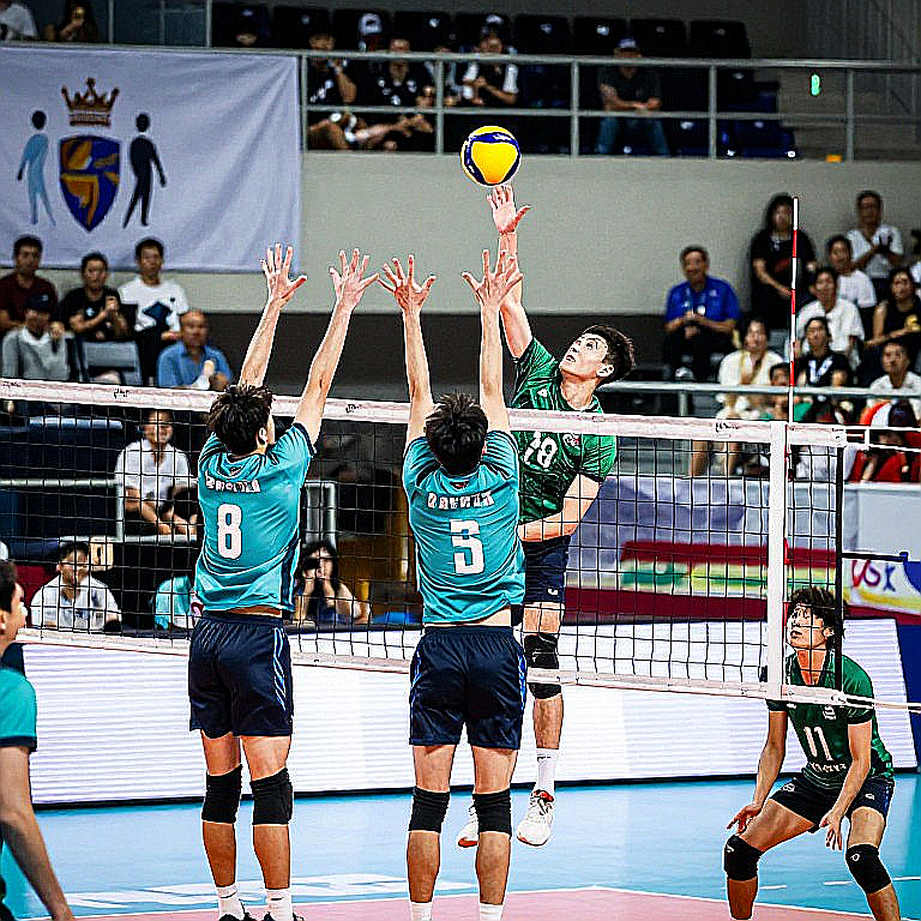
For two sets, that equation worked almost perfectly. Set one, Thailand won 25-23. Set two, they lost 21-25 but kept their rhythm. Thatdao, Sasipaporn and Pornpun repeatedly made China's block hesitate. In my notebook, I marked that as the most important signal of the first half: when Thailand's three attacking options appear at three different points along the net, China's block is forced to guess.
Elite volleyball, at its deepest level, is a sport of wrong guesses. You win when you make the opponent guess wrong more often than you do.
Then set three arrived at 11-25.
Eleven to twenty-five. Not a lost set. An erased set. In roughly fifteen minutes, Thailand conceded 14 more points than its opponent. Across the whole match, Thailand scored 91 points, China 114 — a 23-point deficit, despite Thailand winning two sets.
The pattern has a name: high variance. A team can hit an extremely high ceiling for a short stretch while its floor sits far below the opponent's. Tactically, this has a very concrete cause — the first-contact and distribution system becomes fragile the moment tempo drops.
It helps to picture the mechanism. Thailand does not play with power. They play with rhythm. Pornpun, at setter, must deliver the ball to her attackers so fast that China's block cannot close. To do that, the first ball must be near-perfect. When China raises the weight on its serves, and when the first ball is pushed out of the ideal position, Pornpun loses half her options. At that point the ball has to go to the wing, and that wing swing runs straight into the tallest block on the other side.
That is how sets three and five collapsed. Not because Thailand forgot how to play, but because their system depends on an extremely demanding input condition, and that condition was eroded point by point.
A caveat on the limits of this analysis is necessary here. Everything above is inferred from score progression and squad structure, because the tournament published no attack efficiency, no first-contact quality, no successful block counts. What I describe about China adjusting its serving and blocking after set one is grounded speculation, not data. I state that plainly for a professional reason: when data does not exist, writers easily turn speculation into assertion, and readers lose the right to tell the two apart.
Set four was the moment Thailand proved the opposite. They won it 28-26, after saving multiple match points. I have no official figure for how many match points they saved. That irritates me more than anything else in this match.
When a continental-level tournament publishes no attack efficiency, no first-contact quality, no block counts, the public is left to trust the memory of spectators. The hero is not the one who scores, but the one who gets up after a collision nobody whistled. But when data does not exist, that hero exists only because we remember them. And memory has no appeals mechanism.
What I do know: in set four, Thailand still had a body to defend with. By set five, they did not.
The 6-15 in set five does not tell a tactical story. It tells a physical one. When the legs can no longer lift the body at the right moment, no tactical system saves anyone. China understood that. They accelerated, pushed the ball into positions that forced Thailand to move laterally, and let fatigue finish the rest.
One detail goes largely unnoticed: Thailand's two biggest matches within three weeks both went to five sets. The continental final dragged them into a decider, and three weeks later the Asian Games semifinal took them to the same threshold. For a team that plays on rhythm, playing two five-set matches at the highest level inside three weeks is not a mental challenge. It is a physiological one.
There is a reading of this match I consider wrong: treating it as the story of a small team that was brave but not strong enough. That reading sounds humane, but it strips Thailand of the most important thing they have — agency.
Thailand did not lose because it is weak. It lost because it chose a path with only one exit: maintain near-perfect tempo across five sets. That is a strategic choice, not a fate. The problem is that the cost of that choice accumulates point by point, and the interest is paid in legs.
The more worrying issue lies elsewhere. The continental title three weeks earlier may well have masked a question about squad depth. In both the final and the semifinal, the names that surfaced were still Thatdao, Sasipaporn, Pornpun. Three names. When a continental-level team is defined by three individuals in its two biggest matches three weeks apart, that is the signature of a system operating at its upper limit.
I do not have enough data to conclude whether this is a depth problem or simply a coaching staff's selection preference. But there is one simple test I have not seen anyone run: if Thailand had to play another semifinal next week, what percentage of the squad could they rotate without losing their tempo?
I once spent seven months in a room because of exhaustion and depression, so I know something the stat sheet cannot measure. An athlete's body is not a variable that can be substituted with willpower. Exhaustion is a lesson, and the sporting heart knows how to recharge itself. But recharging takes time, and the international calendar gives nobody time.
There is one more layer of regional context. Thailand is currently the only Southeast Asian representative capable of going toe-to-toe with the two leading continental sides in a five-set format. That is a position worth acknowledging. But Southeast Asia is not a single entity. Thailand being far ahead of the rest raises a different question: when only one country in the region produces a generation capable of competing with China, where are the others accumulating experience? Vietnam, Indonesia and the Philippines are all rising in women's volleyball, but they are rising along different paths, with different resources. Lumping them together would be an analytical mistake.
Thailand will meet China again. They will lose more sets like 11-25 and 15-6 if the squad structure does not change. But what I believe will change is not the result.
It lies in the fact that this generation is creating a standard it must now surpass itself. Three weeks ago they won Asia. Today they lost a semifinal. The distance between those two events is 21 days, and the entire story of Southeast Asian women's volleyball fits inside that distance.
SEA Games 29 taught me that the victory of the silent often echoes the furthest. But it also taught me that a victory arriving too fast can make people forget what it cost. Thailand paid the price. What remains of the next 21 days is what they will do with that time — and whether anyone outside Southeast Asia will bother to look at their real scoreline, rather than only at the medal.

Cầu thủ liên quan
Bài đề xuất
Thailand Women's Volleyball Collapses in Set 5 Against China: Speed Hits a Physical Ceiling2026-09-21
Estonia beat Finland 3-2 in Tampere: the pool stage's finest win and a ticket that never existed2026-09-19
The Rhythm Keeper: Vietnam Volleyball's Setter Problem2026-09-18
India Sweep New Zealand at AVC 2026: Quarterfinal Berth Hinges on Oman–Bahrain Clash2026-09-10
Fukuoka opens the journey to secure Olympic 2028 berth: Japan and the challenge of defending the Asian throne2026-09-04
Brazil Dominates FIVB Rankings as Rio Hosts 2027 Women's Volleyball World Championship2026-09-08
2026 AVP League Championship: Unprecedented Dominance and the Lesson of Block Suppression2026-09-11
Vietnam Women's Volleyball After South Korea: The First Step and the Breath at 24-232026-09-19
Bài đề xuất
AVC 2026: Korea Breaks Semifinal Drought, China and the Paradox of 17 Blocks2026-09-12
Payrolls, Foreign-Player Slots and the Quiet Chess Game of Vietnamese Volleyball2026-09-13
Women's Volleyball at the 2026 Asian Games: Eight Japanese Names, Zero Indonesian Names and a 'Complete Schedule' That Never Was2026-09-17
2027 Women's Volleyball World Cup: 18 Spots Are Locked, and the Rest Is Where It Gets Scary2026-09-16
2027 FIVB Women's Volleyball World Cup: 18 Spots Filled and the Price of the Three-Per-Confederation Formula2026-09-16
Kentucky Rally Past Louisville After a .079 Set: Lessons From a Self-Correcting Offense2026-09-21
Vietnam Women's Volleyball on the Big Stage: When the Reception System Becomes Destiny2026-09-13
Gabi by the pool and the comfort-zone exit: A lesson for hitters who dare to dream beyond Brazil2026-09-09
Bài đề xuất
Fukuoka Day Two: A 13-Year-Old's Block and the Real Invoice of Asian Volleyball2026-09-17
Anatomy of Modern Volleyball: Nine Layers of Data and the Silence That Cannot Be Measured2026-09-14
2026 AVP League Championship: Champions solidify their dominance2026-09-11
Gabi by the pool and the comfort-zone exit: A lesson for hitters who dare to dream beyond Brazil2026-09-09
Quynh Huong, 46 Points, and the Gap No One Has Measured Against China2026-09-20
Nishida's 82% and the 'undefeated' shield: What is Japan hiding in Fukuoka?2026-09-09
Kentucky vs Louisville: The 0.079-to-0.420 Flip and the Data Trap Nobody Verified2026-09-21
Bài đề xuất
Double Crisis: Depleted Attack Line, Vietnam Women's Volleyball Enters Asiad 20 with a Fragile Core2026-09-04
Thailand Women's Volleyball Collapses in Set 5 Against China: Speed Hits a Physical Ceiling2026-09-21
Estonia beat Finland 3-2 in Tampere: Pool C closes as hosts miss out on a share of top spot2026-09-19
AVP League Championship 2026: When the Block Is Neutralized — Decoding the Two Beach Volleyball Finals2026-09-11
Thailand eliminated from 2026 Asian Championship: Dream shattered after loss to Australia2026-09-11
Reading Volleyball Through Data: The Discipline of Someone Who Does Not Predict the Future2026-09-18
Nebraska Sweeps Creighton 3-0 and the 15,405 Attendance Record: When the System Speaks2026-09-19
2026 Shriners Children's Showdown: ACC-SEC Clash Reshaping the NCAA Women's Volleyball Map2026-09-03